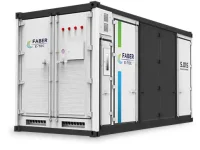
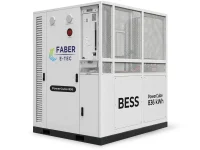
Faber E-Tec - Connecting energy intelligently
Low-voltage flexibility: 400V | 690V | 800V
Our Transformatorlösungen are specially designed to provide modern Battery storage systems efficiently and reliably. Thanks to our experience in transformer construction, PV technology, energy technology and system integration, we offer transformers that are customised to the requirements of standard BESS-technologies:
- Low-voltage outputs in 400V, 690V and 800V - fully compatible with commercially available battery inverters.
- Optimum adaptation to DC/AC system topologies for stationary storage systems, on/off-grid applications and grid services.

IT and TN systems for maximum network compatibility
We deliver Transformers, that support both IT and TN network systems.
This allows:
- Flexible mains connection of the BESS systems (depending on standard requirements, application or manufacturer specifications).
- Safe galvanic isolation - particularly important for mains-coupled systems with insulation monitoring.
- The option of fine-tuned grid integration, even in complex hybrid solutions.
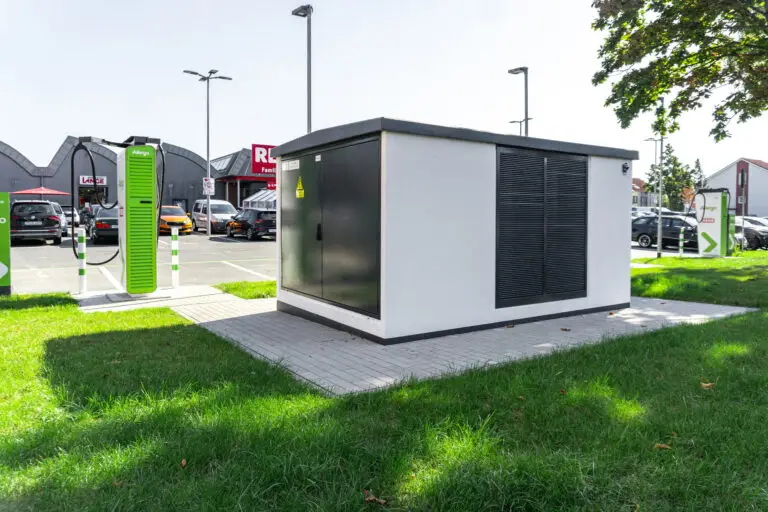
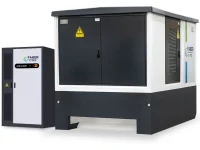
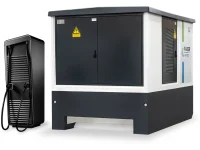
Compact transformer stations from 250 kVA to 3,150 kVA - modularly expandable
Our Transformer stations cover a wide range of services:
- Standard output from 250 kVA to 3,150 kVA - ideal for commercial and industrial applications. Storage solutions or trading memory
- If required, we can realise outputs of up to 20,000 kVA, depending on the voltage level of the medium voltage, the operating environment and the medium-voltage technology used.
- Modular design: Combination with additional function modules (e.g. transfer restriction, switching technology, metering points, energy management units).
Areas of application
Our transformers and transformer stations for BESS systems are used in a wide range of applications - from charging infrastructure with buffer batteries and industrial storage solutions for peak shaving and self-consumption optimisation to control power, hybrid systems with PV, wind or diesel and scalable trading storage systems.
- Charging infrastructure with backup batteries
- Industrial storage for peak shaving / self-consumption optimisation
- Provision of balancing power / grid services
- Hybrid solutions in combination with photovoltaics, wind or diesel generators
- Trading memory

Conclusion
With transformers and transformer stations from Faber E-Tec you receive a future-proof, standard-compliant and customisable solution for integrating modern battery storage systems - whether for industrial applications, energy suppliers or complex grid connections.

🔌 Battery storage planned?
Our compact transformer stations are optimised for BESS applications - including medium-voltage connection and protection technology. We supply the right Compact station for your energy storage system.
🔋BESS - FAQs
What is a BESS?
A BESS (Battery Energy Storage Systems) is a battery storage system that temporarily stores electricity (e.g. from the sun or wind) and feeds it back into the grid when required - for example when generation and consumption diverge.
How does a BESS work?
- Charging phaseEnergy is stored (from the grid or generator).
- Discharge phaseEnergy is drawn as required and fed into the AC grid via inverters. An energy management system (EMS) optimises charging/discharging curves and protects against overloading.
Which technologies are used?
Most commonly lithium ions, but also sodium ions or stationary systems such as sodium-sulphur.
How long does a BESS last?
Usually 5 to 15 years - depending on condition, use and technology.
What advantages does BESS offer?
- Grid stability: Buffer function for load peaks or feed-in fluctuations.
- Cost optimisation: storage of cheap energy, use at expensive peak times.
- Independence: Self-sufficiency in the event of grid failures or unstable supply.
- Environmentally friendly: Promotion of renewable energies.
When is stored energy used?
- At peak load times (expensive electricity prices),
- at low generation (e.g. at night),
- as an emergency power supply in the event of mains failures.
Are BESS suitable for private and commercial users?
Yes, for home, industry and supply networks - they adapt to different sizes and requirements.
What are the components of a BESS?
- Battery cells/modules
- Battery management system (BMS)
- Inverter
- EMS (energy management system)
- Safety equipment (cooling, fire protection)
Which safety aspects are important?
Fire protection is crucial: systems include modern detection and extinguishing technology, physical separation of individual units and strict standards.
Are there environmental and regulatory requirements?
Yes: From 2026, the EU will require CO₂ footprint labelling for industrial systems from 2 kWh.
If you need advice on suitable system sizes, costs, funding or authorisation, I will be happy to help - just let me know! Ask ChatGPT sources