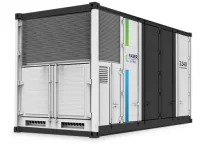
BESS Container | Large-scale battery energy storage systems for industry and solar farms
BESS POWER BLOCKS
Container energy storage system | BESS
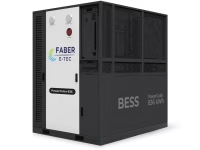
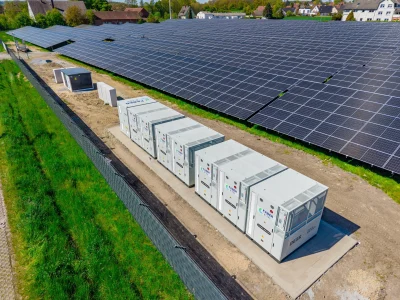
Energy storage systems with 2,507 kWh, 3,340 kWh or 5,015 kWh. Three configuration levels in an identical 20-foot container.
The PowerBlock is a plug-and-play battery energy storage system for commercial, industrial and grid-tied applications. All three expansion stages use the same LFP battery clusters and the same container shell – you plan the footprint once and decide on the capacity as needed. By connecting to the spot market, the stored energy can be traded with exchange optimisation.
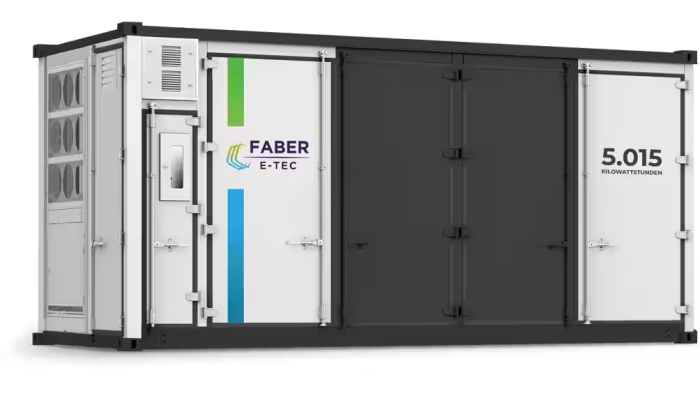
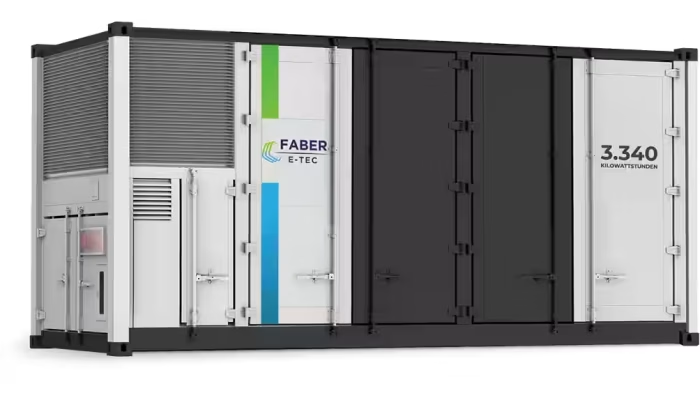
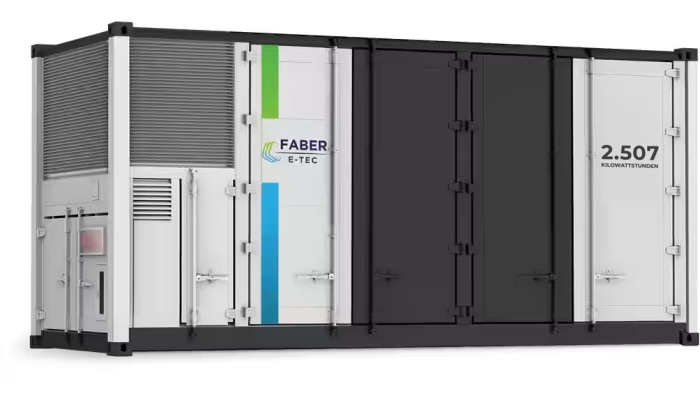

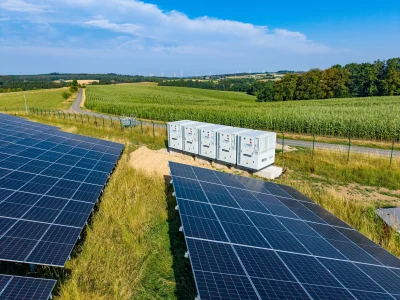
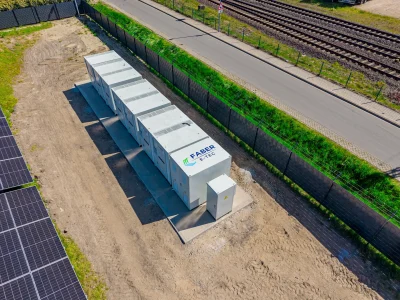

Three capacities, one container shell
The configuration levels differ in the number of battery clusters and inverters. Dimensions, grid codes and fire safety concepts are identical for all three – meaning you can plan the foundations and grid connection point independently of any later capacity decision.
PowerBlock 2M
PowerBlock 3M
PowerBlock £5M
Double capacity of the 2M on the same footprint, with liquid cooling for the higher power density.
Two ways to connect to the grid
The DC container is identical in both variants; the difference lies in where the inverter, compact transformer and switchgear are housed. For individual energy storage systems, the compact two-container solution is usually the quicker route.
As soon as several DC containers converge at a grid connection point, separate installation demonstrates its strengths: a single transformer station then serves multiple storage units, and the grid layout can be designed more flexibly. Which variant is more cost-effective depends on the planned final expansion stage.
BESS DC container + AC cabin

- Integrated transformer
- Integrated HV switchgear
-
PCS in its own container -
Separate transformer station - Compact 2-container solution
- Installation & set-up effort
- Flexibility in network concepts
- Maximum scalability (multi-MWh)
BESS DC container + PCS container + Transformer station

-
Integrated transformer -
Integrated HV switchgear - PCS in its own container
- Separate transformer station
-
Compact 2-container solution - Installation & set-up effort
- Flexibility in network concepts
- Maximum scalability (multi-MWh)
PowerBlock solutions at a glance
Configuration options
AC cabin
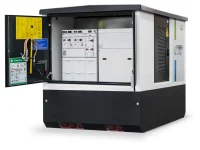
The AC cabin combines the transformer, PCS and high-voltage switchgear in a pre-assembled 30 ft unit. It enables fast, grid-compliant installation and forms the complete AC interface between the BESS and the medium-voltage grid.

PCS container
The PCS container houses the complete power electronics for bidirectional energy conversion. With 2 × 1,290 kW PCS, it ensures reliable, grid-compliant AC/DC conversion and maximum operational stability in multi-MWh applications.

Compact station
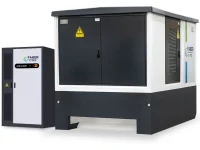
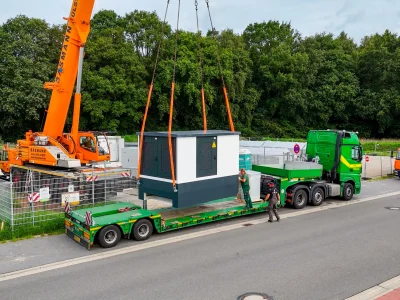
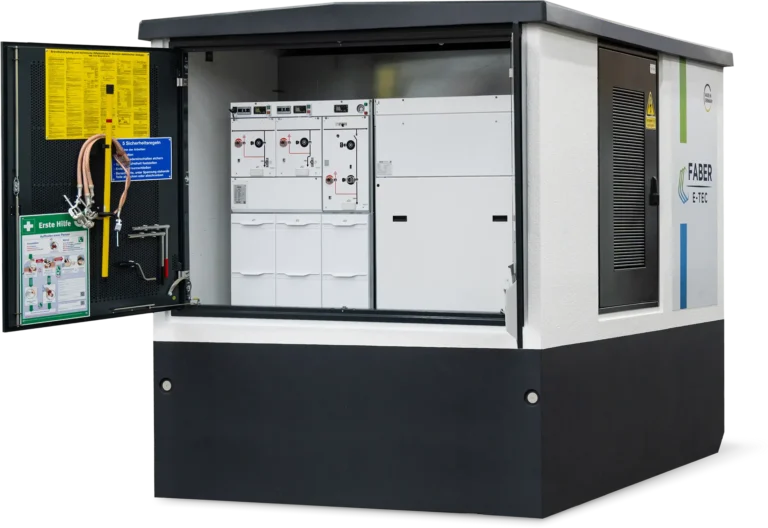
Our compact substations for BESS systems safely connect energy storage units to the medium-voltage grid. We take care of the design, construction and maintenance – all from a single source.

Module-level fire protection, built for outdoor installation
Installation is carried out on a strip or slab foundation. We determine the required distances to neighbouring buildings and other containers on a project-specific basis as part of the fire protection and approval concept.
multi-stage fire safety concept
- Fire extinguishing agent at module level: Heptafluoropropane or perfluorohexanone is discharged directly at the affected module, rather than throughout the entire container space.
- Aerosol fire suppression system Supplementary extinguishing system for the container room.
- Combustible gas detection: Detects escaping electrolyte gases before an open flame occurs – the crucial head start in the event of thermal runaway.
- Explosion-proof ventilation system: Safely vents fuel gases and prevents the build-up of an ignitable atmosphere.
Built for outdoor installation
The PowerBlock does not require a technical building. The container housing is rated to IP54, whilst the PCS is rated to IP66. The operating temperature range is from −30 °C to +55 °C at 0 to 95 % relative humidity, non-condensing; the maximum installation altitude is 2,000 metres above sea level.
Against lightning and switching overvoltages, the storage system is protected on both the DC and AC sides by Type II surge arresters. The noise level is a maximum of 65 dB.
PowerBlock technical specifications
Liquid cooling
Even heat dissipation
Automatic fire control
Safety & Durability
Weatherproof & robust
Weatherproof & robust
Intelligent control
Sustainable lithium iron phosphate technology with high cycle stability and low maintenance requirements.
Tested safety and protection for industrial battery battery energy storage systems (BESS).
Increased security
All climate zones
Standard size
The Power Block BESS Container was developed for the highest industrial Safety requirements developed. A multi-stage protection and monitoring system ensures maximum operational safety, reliable heat dissipation, and effective fire protection, even under demanding environmental conditions and in all climate zones.
Design & Sizing
Which PowerBlock is right for you? Simply send us the key data regarding your infrastructure: your load profile or annual electricity consumption, the capacity of your current grid connection, and the available installation space.
Get PowerBlock online now request
"*" indicates required fields
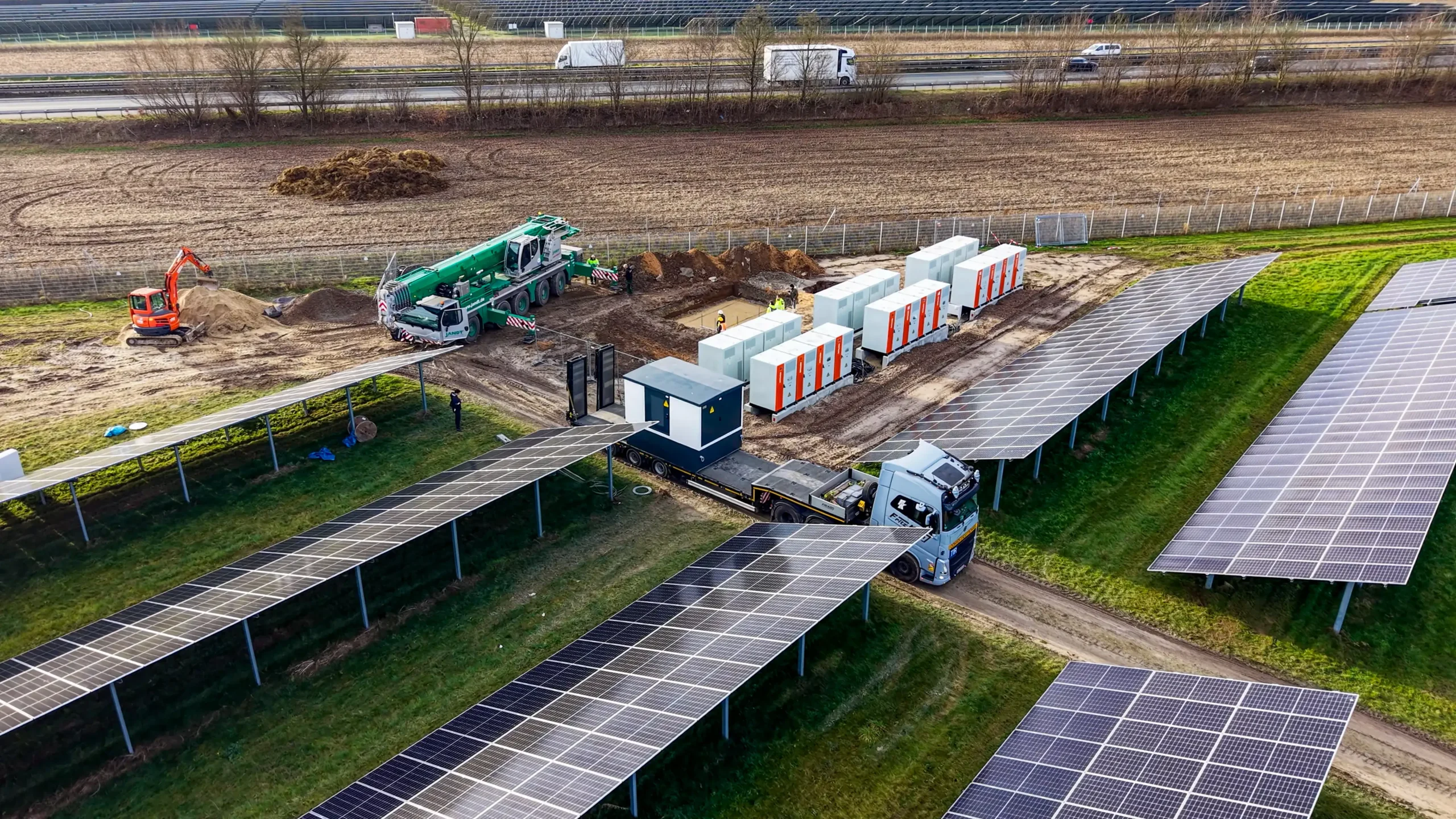
To match our PowerBlocks Battery storage systems Does the Faber E-Tec supply the complete Network connection. We design and realise bespoke compact substations that match the power rating and inverters of your BESS Containers work in harmony. This is how we ensure a smooth grid connection.
large-scale battery energy storage systems EPC
F sharpber E-Tec plans, procures and installs BESS containers as an EPC partner – from sizing based on your load profile data through grid connection planning in accordance with VDE-AR-N 4110 to Commissioning. The appropriate Design and manufacture transformer substations ourselves, and we work according to ISO 9001 and ISO 45001. For the storage projects that we have realised had, was the decisive point rarely the battery – but the Coordination between storage, Medium voltage and network operator. Exactly that is where our main focus lies. Learn more about EPC BESS
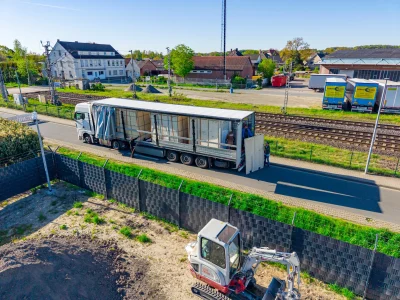
Battery clusters, inverter, thermal management and fire protection system are already integrated, wired and factory-tested within the container. On-site work is limited to the foundation, cable connection and commissioning. This significantly shortens construction time compared to individually assembled systems and makes the schedule reliable. If demand grows, we install additional containers in parallel: The expansion stages 2M, 3M and 5M use the same container shell with a 14.8 m² footprint, allowing the foundation and grid connection point to be planned independently of the capacity decision.
As an EPC partner, we take care of the design, procurement and construction of your BESS container, operating in accordance with ISO 9001 and ISO 45001. The system components are certified to IEC 62109-1/2, IEC 62477-1 and IEC 61000-6-2/4, and the grid connection complies with VDE-AR-N 4110 or 4120 respectively. We develop and manufacture the appropriate medium-voltage solution and transformer station in-house. This means that the most critical interface of the project – the one between the storage system and the grid connection point – lies with a single responsible party rather than being split between two suppliers. We guarantee deadlines and milestones contractually.
Every BESS container is equipped with an energy management system (EMS) that monitors the storage system in real time. Operating data, state of charge and system messages can be accessed remotely – from the office, the control room or on the move. This yields two practical benefits: deviations are noticed before they lead to a failure, which is what makes predictive maintenance possible in the first place. Furthermore, the operating strategy can be aligned with the load profile and electricity price, rather than charging and discharging according to a fixed schedule. This data access is a prerequisite for direct marketing.

Start your PowerBlock project
Simply send us your load profile data or project documents. Our engineers will analyse your specific load profile and prepare a sound economic forecast for your PowerBlock. BESS container – transparent, data-driven and non-binding.
Container Storage System - FAQs
Which finish level fits my project?
What distinguishes the PowerBlock from the PowerCube?
The PowerCube is a storage cabinet with 418 or 836 kWh for commercial projects and smaller utility-scale systems. The PowerBlock is a 20-foot container starting at 2,507 kWh, making it designed for the megawatt class. The transition practically lies where multiple cubes can no longer be sensibly paralleled.
Why is the 5M liquid-cooled, but the smaller stages are not?
With twelve clusters in the same volume, the power loss per cubic metre increases significantly. Air cooling then no longer achieves a uniform cell temperature, and temperature differences between modules shorten the service life. Liquid cooling in the 5M keeps the cells more closely within the design window – that is the technical price of higher energy density.
How is the fire protection designed?
Can the container be left outdoors?
Yes. The housing is rated to IP54, whilst the PCS is rated to IP66. Operation is permitted at temperatures ranging from −30 °C to +55 °C, with relative humidity of 0 to 95 % (non-condensing) and at altitudes of up to 2,000 metres. A technical building is not required.
Can several containers be combined?
BESS Container Project Workflow | Large-Scale Battery Storage Systems by Faber
A commercial BESS project (Battery Energy Storage System) is not an off-the-shelf solution. For maximum profitability and grid stability, we begin with a precise analysis of your data. The result: A tailor-made BESS Container industrial battery storage system that matches your load profile, the planned grid connection, and your marketing strategy precisely.
Step 1: Request & transmission of load profile data
Here is how your BESS project works: from load profile analysis and the bespoke BESS container quote to commissioning and electricity trading. You send us your load profile data, annual electricity consumption or the complete project documentation for your solar park – easily via our enquiry form, by email or telephone. If a preliminary enquiry or grid connection commitment from the grid operator is already available, we integrate the specifications regarding the voltage level and grid connection point directly into the technical planning of your BESS container.
Our engineers evaluate your energy data, determine the optimal storage capacity and C-rate of the BESS container, and examine the revenue potentials. In doing so, we focus on the most lucrative use cases for you: peak shaving to reduce grid fees; optimisation of self-consumption from PV systems; energy trading and marketing on the spot market. You will generally receive your project-specific economic forecast for the container storage system within seven days of receipt of complete data.
System integration from a single source: with us, you receive the finished BESS container including the precisely matched transformer station (compact substation). Our range of services includes the complete medium-voltage connection, the certified protection concept and smooth grid connection in accordance with VDE-AR-N 4110 / 4120. Following successful hardware commissioning, we do not leave you on your own: upon request, Faber Energy Trading will take care of ongoing marketing and automated storage trading for you.