Downloads
Technical data sheets for all Faber E-Tec products
Substations - Data sheets
To the FAQ
From design to implementation – we guide you personally through your project. Ab Stock available systems and optimised Processes ensure a prompt Delivery of your project.
Frequently asked questions
Everything you need to know about our data sheets and downloads
Substations - FAQ.
Can the compact station be customised to meet special requirements?
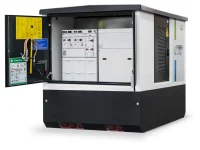
Yes. We tailor our compact substations individually to your requirements – from the respective grid conditions to the specific operating conditions on site. This ensures you receive a solution that is precisely tailored to your project.
How is the compact station transported and installed?
The transport is carried out as heavy haulage and is fully coordinated by our logistics team. On site, our specialists handle the professional installation and commissioning of the station.
What advantages does the solar park station offer over conventional solutions?
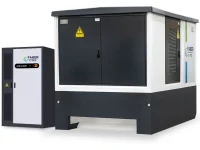
By omitting LV HRC fuses, the solar farm substation operates more efficiently and generates less heat – which reduces maintenance requirements and extends the service life. The integrated insulation monitoring also ensures greater safety and reliability in the IT system.
What information is required for planning a transformer station for BESS?
For a tailored design, we need:
- the required medium-voltage level (e.g. 10 kV, 20 kV)
- the battery voltage (e.g. 400 V, 800 V)
- the maximum charge/discharge current (C-rate)
- the storage capacity (kWh)
- the requested output (kW/kVA)
- Location and responsible network operator
The more precise these details, the more accurately the station can be tailored to your project.
Battery Energy Storage System - FAQ.
What are the transport costs and which Incoterm is used?
We deliver according to Incoterm DPU (Delivered at Place Unloaded), not EXW. The transport costs depend on the respective delivery location and are shown individually in each quotation.
What warranty services does Cospowers offer for the BESS components?
- 5-year warranty on the PCS (Power Conversion System)
- 10-year or 10,000-cycle warranty on the battery cells
- 20-year availability guarantee on new cells
Can the warranty be extended? How much does that cost?
Yes. An extension to 15 years is possible and costs approx. £15/kWh as a one-off payment at the start of the contract.
Where can I find the full warranty conditions?
We are happy to provide you with the complete Cospower warranty conditions as a PDF for download.
Does the container require a bund for water protection?
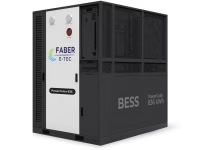
No. The container has an IP55 protection rating and is therefore protected against jets of water from any direction. An additional drip tray is not required.
Which extinguishing system is used in the event of a fire? Is fire water retention required?
The container features an integrated aerosol-based fire protection system. As no extinguishing water is used, no fire water containment is required.
Are there any records on the water hazard class (WGK) and further safety certificates?
Yes. Available are:
- Supplementary sheet for water hazard class pursuant to § 3 para. 3 VwVwS/AwSV
- UN38.3 test report
- Safety Data Sheet
We are happy to provide these documents to you upon request.
Are there foundation plans? Can dry foundations be supplied as well?
Foundation plans are available to download for both options. We do not supply dry foundations ourselves, but are happy to put you in touch with an experienced partner for their installation.
Are there any details regarding noise emissions?
You can find the essential acoustic values in our technical data sheets. Detailed test reports are available on request.
Do you provide installation and maintenance documentation?
Yes, project-specific installation and maintenance documentation will be provided as part of the delivery process.
How is battery degradation (State of Health) calculated?
The degradation of the storage system depends on the individual number of cycles in the respective project and is calculated specifically for the project by the manufacturer – for example at 0.5C and 365 cycles per year. We would be happy to prepare a suitable calculation for your project.
Do you also offer a 1-hour system?
Currently, we do not offer a 1h system. While the cell technology would be technically feasible in principle, it would lead to significantly higher degradation – which is why this configuration is currently not standard in the industry.
Switchgear - F.A.Q.
What is the difference between NSHV, NA protection and AC combiner?
The LVMS (low-voltage main distribution board) distributes and protects electrical energy on the low-voltage side of the system. The grid and system protection monitors the grid and automatically disconnects the system from the public grid in the event of a fault. The AC combiner bundles the alternating current lines of multiple generators or storage systems before they are fed in together.
Are the switchgear assemblies designed for use in solar parks and BESS projects?
Yes, our switchgear is designed for use in PV installations, battery storage projects and industrial energy systems, and can be configured to suit the respective project size.
Do the switchgear assemblies comply with the current grid connection standards?
Yes, our switchgear systems are designed and tested in accordance with the relevant VDE standards and grid connection guidelines for the German market.