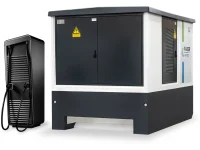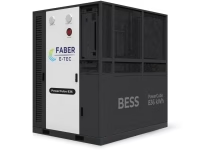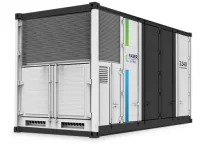
Structure, function and importance in the power grid
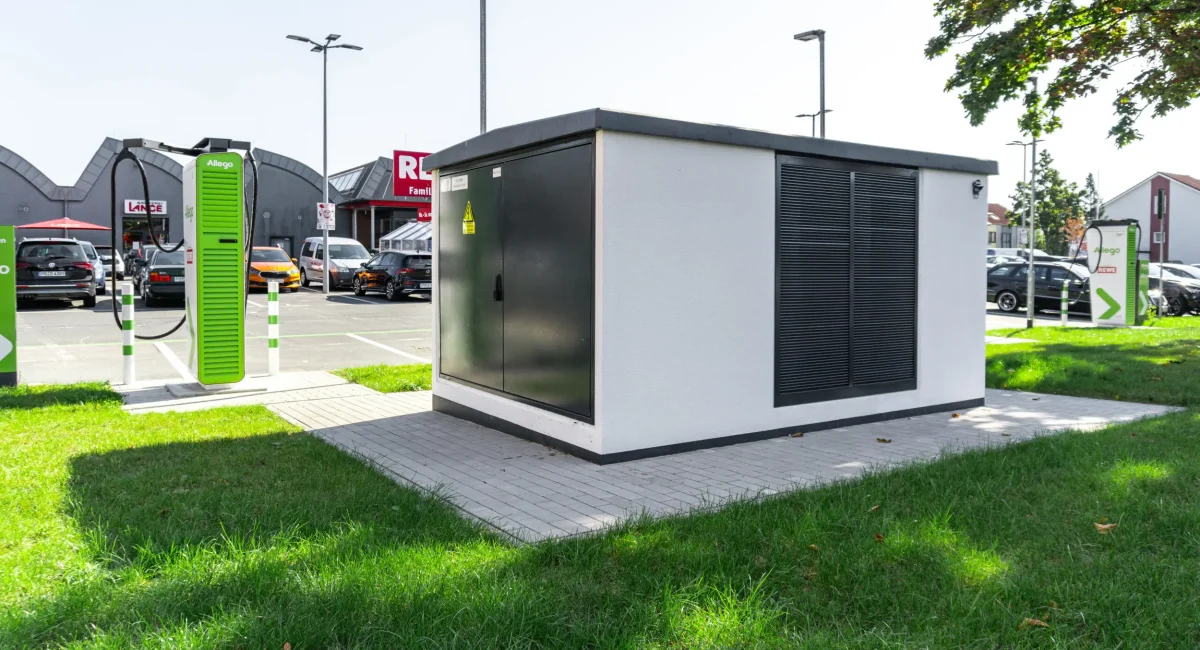
You see them almost daily on roadsides, in residential areas or next to large solar parks: small, unassuming buildings, often made of concrete. Yet without them, the lights would literally go out for us. Transformer substations / Compact stations (short for transformer stations) are the crucial link in our electricity grid.
In this article, we explain simply and clearly what a transformer station is, which components it consists of and why the expansion of renewable energies and Battery storage systems (BESS) has radically changed the requirements for these stations.
The simple definition: What is a transformer station?
A transformer station converts electrical energy from the regional Medium-voltage grid into the low voltage usable for the end consumer – or vice versa.
You can think of the electricity grid like a road network:
The large high-voltage power lines are the motorways on which huge amounts of electricity are transported over long distances. The medium-voltage network (mostly 10 kV to 30 kV) corresponds to the main roads. However, our household appliances or normal industrial machines require a much lower voltage (230 V or 400 V) – the local streets.
The transformer substation acts as a interface and pressure reducer. It takes the „high-pressure“ current from the medium-voltage grid and „transforms“ it down to the required low voltage so that it can be safely used in homes or businesses.

The design: What components does a transformer substation consist of?
Despite different designs, at their core every transformer substation consists of the same main electrotechnical components:
Medium-voltage switchgear Ms: This is the entrance area of the substation. Here, the installation is connected to the network operator's regional power grid. The switchgear also serves to safely isolate the substation from the grid during maintenance work or faults.
Transformer (The „trafo“): The heart of the system. The transformer is an electromagnetic converter that carries out the actual voltage change (e.g. from 20,000 volts to 400 volts).
Low-voltage main distribution board (NSHV): Here, the stepped-down electricity is distributed to the various outgoing cables that lead to the final consumers (houses, charging points, factory buildings). The fuses for the local circuits are also located here.
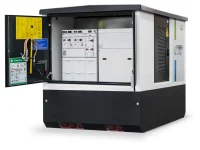
Station enclosure: To protect the sensitive technology from the weather and unauthorised access, it is usually installed in robust housings made of reinforced concrete or special container designs.
What types of transformer substations are there?
Depending on the application, a distinction is made between various designs:
Secondary substations: The classic, often walk-in concrete utility substations of the municipal utilities for supplying residential areas.
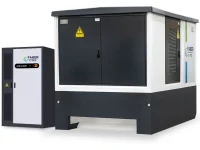
Industrial compact substations: Space-saving, non-walk-in substations located directly on the industrial sites of energy-intensive companies.
Transfer stations (feed-in stations): These substations often work „in reverse“. They take the locally produced electricity (e.g. from a solar farm), transform it to Medium voltage high and feed it into the grid.

The energy transition: why standard stations are often no longer sufficient today
With the massive expansion of ground-mounted photovoltaic systems (solar farms), HPC hyper-charging hubs and large battery energy storage systems (BESS), the role of the transformer substation has changed. It is no longer just a simple power distributor, but the intelligent bottleneck of the energy transition.
For project developers and EPCs (main contractors), these new applications bring massive technical challenges:
1. The heat issue (derating)
A battery storage system or solar park often runs at maximum full load for hours in midsummer. Standard transformer substations are designed for this continuous strain not designed for. The transformers are getting very hot. To Overheating To avoid this, conventional stations cut back their output when outside temperatures are high (a process known as ‘derating’). As a result, solar farms or storage facilities are often only able to feed 60 % to 70 % of their capacity into the grid during the summer. Valuable energy yields are lost.
2. Complex grid connection conditions
The connection of large-scale plants to the medium-voltage grid is regulated by strict standards (such as VDE-AR-N 4110/4120 in Germany). Today, a modern substation requires highly complex grid and system protection concepts to guarantee the stability of the power grid.

The solution for BESS and solar parks: active cooling and "EPC-ready"
To prevent yield losses due to heat, modern infrastructure planners rely on specialised Compact stations.
Here at Faber E-Tec, we have solved this problem with an innovative, active ventilation concept. Unlike conventional standard concrete enclosures, our stations for solar parks and BESS 100 % guarantee performance up to an ambient temperature of 40 °C. Derating – and thus a financial loss in the height of summer – is effectively prevented.
In addition, project developers nowadays look for turnkey solutions to minimise interface risks. As a so-called „EPC-ready“ partner, we supply transformer substations up to 3,150 kVA completely ready for connection: including medium-voltage switchgear, flexible LV outputs (400V/690V/800V) and a certified protection concept. And, given the current market environment, with a reliable delivery time starting from 28 weeks.
Conclusion
The transformer substation is the foundation of our modern power supply. What used to be a simple enclosure for power distribution in residential areas is today a highly complex high-tech interface. Especially in the B2B sector, during the planning of battery energy storage systems and renewable energies, the choice of the right substation is a decisive factor in the economic viability and performance of the entire energy park.
Are you currently planning the grid connection for a BESS– or PVMajor project?
Avoid loss of revenue in the summer and secure reliable supply chains. Download our technical data sheet (2000 – 3150 kVA) here or contact our engineers for a no-obligation consultation regarding your grid connection.
This is how a transformer substation is made! 🏭
A look inside production: The assembly of our compact substations
From concrete pouring to the turnkey handover of our SF6-free systems: take a look behind the scenes of our production. The following video shows the precise assembly of our transformer substations and provides a direct impression of our work on site. See for yourself!
Substation - FAQs
1. What is the difference between a transformer station and a substation?
The difference lies in the voltage level. A substation connects the supra-regional high-voltage grid (often 110 kV to 380 kV) with the regional distribution grid. A transformer station (also known as a secondary substation) is a step smaller: it converts the electricity from the regional medium-voltage grid (mostly 10 kV to 30 kV) into low voltage (230 V or 400 V), which can be used directly by our households, commercial businesses, or charging points.
2. Why does a transformer substation hum? (Noise)
The typical, low hum is caused by the transformer inside the station. The alternating current flowing through it generates a magnetic field that causes the iron core of the transformer to expand and contract in tiny vibrations – a physical effect known as „magnetostriction“. In modern compact substations, such as those built today for industry or solar parks, this noise is heavily insulated by special dampers and massive concrete housings.
3. Why do solar farms (PV) and battery energy storage systems (BESS) need their own transformer stations?
Transformer station - energy transition in Germany
Explanatory video: Energy infrastructure for photovoltaics and BESS
Further links
Complex grid connection conditions
The connection of large-scale plants to the medium-voltage grid is governed by strict standards such as the VDE-AR-N 4110 regulated in Germany.
Transformer
The transformer (often called a „trafo“ for short) is an electromagnetic converter that carries out the actual voltage change. You can find out more about this in the general definition of the Transformer.
legislation
All our stations comply with current safety regulations, including the
26th Ordinance for the Implementation of the Federal Immission Control Act (26th BImSchV).